Mostrando postagens com marcador Inglês. Mostrar todas as postagens

26.10.09

Looking for Brazil


Afro-Brasil

October 24, 2009 by mceakin
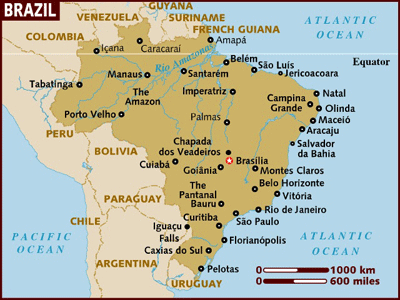
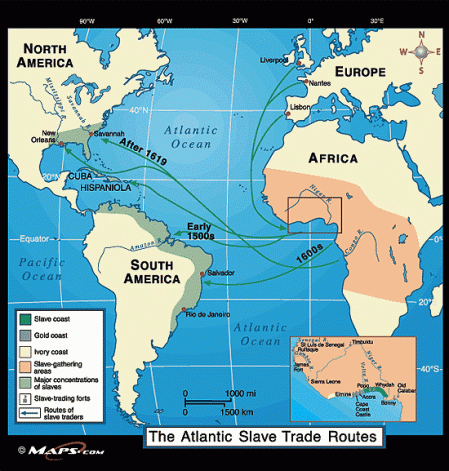
For the past three days I have been in Salvador da Bahia, the old colonial capital of Brazil, and the birthplace of the slave and sugar plantation complex that spread across tropical and subtropical America from the sixteenth to the nineteenth centuries.  It was here in Salvador da Bahia de Todos os Santos (The Savior of the Bay of All Saints) that the Portuguese transplanted cane sugar from their tiny island possessions off the African coast (Madeira in particular) in the late sixteenth century and began to transport black Africans to work on the expanding plantations on the Brazilian coast.  From the 1570s to the 1660s, the northeastern coast of Brazil became the first great sugar plantation of the world driving the rise of the modern transatlantic slave trade, and making sugar a standard part of the diet of the European world.  After 1650, the Dutch, then the British and the French, all anxious to profit from this lucrative enterprise, constructed their own plantations in the islands of the Caribbean accelerating the Atlantic slave trade.  Even after the rise of a gold boom in southeastern Brazil in the eighteen century shifted the flow of enslaved Africans to the previously tiny port village of Rio de Janeiro, hundreds of thousands of Africans continued to flow into the sugar plantations of the region around Salvador.Brazil map
As best we can estimate, about 12 million Africans arrived in chains in the Americas from the early 1500s to the 1870s.  Africans and their descendents eventually could be found working in all the European colonies in the Americas in nearly every sector of the labor force, although the vast majority toiled in the countryside in agriculture.  About one-third of these Africans (3.5-4 million) came to Brazil, about 40 percent to the Caribbean basin (5 million), and only 6-7 percent into what became the states of the U.S. South (about 750,000).  All of these societies were built on the sweat and blood of enslaved Africans and their descendents.  In the cases of Brazil and most of the islands in the Caribbean, the societies had slave majorities, and after emancipation in the nineteenth century, non-white majorities.  (In what is now the United States, only South Carolina had a black/slave majority for a brief period in the eighteenth century.)  Nowhere else in Brazil is the imprint of Africa as pronounced and enduring as Salvador.  According to one traditional Brazilian saying, “If Brazil’s land is American, its façade is European, and its soul is African.”
Slave Routes
Slave Routes
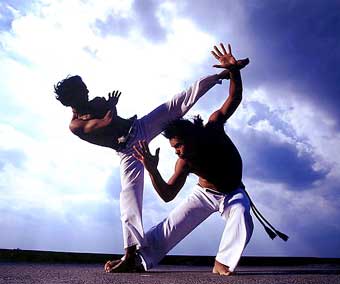
In Salvador, more than 80 percent of the population has African ancestry.  Whether in the faces of the people, the music, food, or religion, the influence of Africa pervades all of Bahian society and culture.  Black women wearing the traditional flowing white dresses and turbans sell traditional sweets and fritters (acarajé) on the streets of the old city center.  Hundreds of terreiros (houses of worship) carry on the centuries of religious rituals and beliefs that are a fusion of African religions and Catholicism known as candomblé.  The vibrant music scene has produced some of the greatest artists in modern Brazil from the popular music of Caetano Veloso and his sister Maria Bethânia to the samba-reggae of Daniela Mercury and Carlitos Brown.  Capoeira, a sort of combination of martial arts and dance moves, has developed over centuries in Salvador supposedly from its origins as staged fights between slaves.  Today, capoeira is practiced nearly everywhere on the globe (including Nashville).
Capoeira
Capoeira
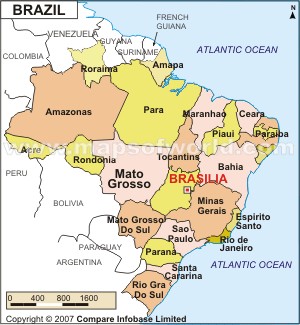
Each time I come to Salvador I am reminded of the incredible diversity of Brazil.  Moving down the coast to Southeastern Brazil, a large part of the population has African heritage, but Rio de Janeiro, Espirito Santo, Minas Gerais and São Paulo form a sort of transition zone from the largely black Northeast to the almost entirely white South.  The three southernmost Brazilian states (Rio Grande do Sul, Santa Catarina, and Paraná) were settled in the late nineteenth and early twentieth centuries by European immigrants and their inhabitants today are more than 80 percent white.  Northern Brazil and the Center-West region are made up primarily of whites or peoples of mixed European and Indian descent.  This enormous country is continuum of colors and peoples spread out across an area larger than Europe.  All across this vast terrain one can find Brazilians of African descent, but it is in Salvador that they are most concentrated and most visible.  Today, the influence of this epicenter of Afro-Brazil continues to exert enormous influence on music, dance, on all of Brazilian culture.  Salvador remains the soul of Brazil.map-of-brazil

11.10.09


Brazil: Hidden Pousadas - Hotel Casa do Amarelindo, Salvador, Bahia

By Alison McGowan
October 2, 2009

The Casa do Amarelindo calls itself a hotel and it is definitely a boutique hotel in terms of luxury. The 10 suites are all spacious with box spring beds, excellent power showers, hairdriers and beauty products in the bathroom. Some have whirlpool baths, and some have balconies, but all have double glazed windows which keeps outside noise to an absolute minimum.

At the same time the Amarelindo is definitely a pousada in terms of charm and atmosphere. French owners Gilles and Didier, refurbished the original colonial house from scratch keeping adding internal tropical gardens, 2 bars and a roof top swimming pool with fabulous views across the bay. Decoration is truly Bahian with strong colours, paintings and sculptures by local artists. The bustle of the historical centre is right outside, but once you are back in the Casa do Amarelindo in the care of its friendly and super attentive staff, you can forget the world outside and just relax in peace.

About the Location
The Casa do Amarelindo is situated right in the historical centre between the Terreira do Jesus and the main Pelourinho square. Salvador itself used to be the capital of Brazil and buildings and particular churches in this area reflect the magnificence of a bygone age of gold and glory - and a rather less salubrious history of slavery. Over 6 million slaves came in to Brazil through Salvador and the African influence is still aboundingly evident in culture, customs, and religion.

Over the last 40 years there have been periods when the local governments has invested in the upkeep of the area, encouraging the refurbishment of colonial buildings and investing in cleaning and policing. Regrettably the present government does not see this as a priority, hence the rundown feel of the area, the dirt, and the return of hustlers, beggars. If you can ignore the poverty and problems for at least the period of your stay, there are a million and one interesting things to do in this area. If this bothers you, much better to stay down in one of the beach areas and just do a guided tour.

Not to be Missed
- Igreja Sao Francisco (San Francisco church)
- Tuesday evening blessing of the city with concerts after
- Mama Bahia and Sorriso da Dada for muqueca
- Guided tour round the historical centre
- Universo Brasil tours with Luiz

Starpoints
* Gourmet restaurant and wonderful caipirinhas
* Super attentive service
* Bahian style & decoration
* Pool and bars at sunset
* Views over the bay and lower city

Try a Different Place if...
... you have difficulty walking or don‘t like seeing poverty up close

Alison is a British writer, musician, and marketing consultant, based in Rio de Janeiro. She can be contacted on alison@hiddenpousadasbrazil.com. Visit her site athttp://www.hiddenpousadasbrazil.com/.
Publicado em Gringoes

30.8.09

Another city...... Off to Pelourinho

Another town!!

I flew into Salvador on Saturday after a few rainy days in Rio. It was nice to fly. I have some friends that I met in Rio and I roomed with them in Salvador that took the bus to save money. It cost them $240 Reals. The bus trip was supposed to take 25 hours but the bus broke down and the trip took 35 hours. I paid $291 Relas and it took me 2 hours. Ha ha!!

 After I found a bus, I arrived at my hostel and found the English couple that I was talking about above. It was nice to know someone there. There were also a big group of Israelis that were there to party no matter what. I spent my first day in a very old city in Salvador called PELOURINHO taking pictures, dodging beggars, and walking my butt off. It was a really neat place and at night it is full of fun. (See pictures of guys with drums) They do street parties where guys with drums play and get the crowds dancing and donating money. 

The band, Salvador, Brazil

Anyway, the first night we stayed in. The second day, my English friends moved out to another room and I got a new roommate. His name is Damien. He is English and came in with a long face. I asked what the problem was and he said that he had just broken up with his Brazilian girlfriend that day. I started to laugh and thought how ironic it was that he and I ended up rooming together and we both were just single from Brazilian women. 

Getting the crowd up for dancing, Salvador, Brazil

Next day, I went to the beach and hung out with the couple. In the evening, we went to a street party. My first night out in a while. We went to the town square and there was live music. In the smaller streets, there was a drum band playing. The crowd loved it. My roommate was pick-pocketed for about $40.00 bucks. We then went to an outside Samba bar and stood around and talked. I left at 12:30 am and went to bed. =)) More beach during the day and at night I cooked spaghetti for a few people and we stayed in. Next day, I cooked some food on the grill and headed out to catch a bus to the bus station. Lesson learned…………… NEVER get on a bus with a big suitcase at 5:00 pm in a city. The people pack in the bus. It is crazy. Lucky for me I had 3 older women felt sorry for me not speaking the language so they looked out for me and told me when to get off the bus. The problem was dragging my bag through the crowd. 

Street party, Salvador, Brazil

So, I climbed on a bus and headed to Recife. On the bus, I met a lesbian that was crying her eyes out because she was leaving her girlfriend in Salvador. A drunken guy speaking Portuguese also harassed me for a few minutes. I pushed him back 2 times but it was not a violent thing. I just moved him. The 2 girls next to me did not know what his problem was. Finally, the man behind me (I think he was military or a federal police man) got up and twisted his arm and moved him back to his seat………… Good times!!!! 


Relato de Ccajoleas do blog Travelpod

27.8.09

Londres - Pelourinho 3 vezes por semana


Air Europa flies high with the introduction of new routes and increased frequency to popular destinations
With the global aviation industry suffering the effects of the recession, Air Europa is set to buck the trend with the launch of its winter schedule in October 2009, including a number of new routes.
Following the successful introduction of twice-daily flights from London Gatwick to Madrid in spring 2009, Air Europa has seen sales figures from the UK exceed initial expectation.
Due to demand from travel suppliers and consumers, Air Europa is reintroducing three weekly flights from London to Salvador de Bahia via Madrid from 3 November 2009. A Boeing 767 will operate the route, offering a two class configuration of economy and business class seats.
Prices from London to Salvador de Bahia will start from £607 return, including taxes. The route to Salvador de Bahia is expected to attract a mix of leisure and business travellers.
Air Europa’s service to Argentina has proved so successful that the winter schedule will see flights increase to once a day from Buenos Aires. A fleet of Airbus A330-200 will operate on the route with prices from London via Madrid starting from £530 return, including taxes.
The introduction of the winter schedule will bring passengers an excellent way to reach the winter sun destinations of Palma de Mallorca and the Canary Islands of Las Palmas and Tenerife via Madrid. The afore mentioned destinations have short connection times in Madrid and it is also possible to travel with Air Europa to Gran Canaria, Lanzarote, Fuerteventura and the Balearic Islands of Ibiza and Minorca.
The airline is also launching three daily flights to Lisbon via Madrid. Looking further afield, Air Europa is also announcing a weekly transatlantic flight between Tenerife North and Miami, securing its position as the only carrier to offer a non-stop service to the US from either of Tenerife’s airports.
"Following the success of the new London Gatwick to Madrid route, Air Europa is fast becoming known as a South American specialist airline. We are proud to offer our customers even more new routes and an expanded winter schedule." says Colin Stewart, UK General Manager. "Air Europa’s commitment to competitive pricing and exemplary customer service has significantly strengthened our position in the UK market."
British Airways’ decision to cut all flights from London Gatwick to Madrid from 25 October 2009 will make Air Europa the only trade-friendly carrier offering this route.
Air Europa’s London Gatwick to Madrid route provides regular connections to a host of exciting destinations in South America and the Caribbean including Havana (Cuba), Buenos Aires (Argentina), Salvador de Bahia (Brazil), Caracas (Venezuela), Cancun (Mexico), Punta Cana (Dominican Republic) and Santo Domingo (Dominican Republic).

24.8.09

Reflexões: Be Slow to Judge - The trickiness of race and class

Texto de Mariama White-Hammond
http://mariamastrippin.blogspot.com/
Foto:Natan's Piva Page
http://tinyurl.com/mkc3dd


Be Slow to Judge - The trickiness of race and class

Last night I went out for my last walk through Pelourinho before my early flight for this morning. On my way to say goodbye to a friend I ran into a couple that was struggling with very limited Portuguese to find a 24-hour ATM. I stopped to do a little translation and then gave them some recommendations for how they could stay safe late at night.

After running some of my last errands I ran into them again and they invited me to have a drink. I was in a hurry to get to a 2nd birthday party for a friends son so I could not really join them but the man mentioned that Salvador was not what they had expected. He commented that the worlds seemed so “separate”. While I have known that Brazil can be a very segregated place, I had gotten pretty comfortable and had stopped noticing the fact that Pelourinho is the downtown center of African descendants while other popular hang outs like Rio Vermelho and Barra are much lighter. You see white people around Pelourinho, but they are mostly tourists – not elite Bahians. In contrast, my one experience at a bar in Barra had me feeling pretty dark.

The couple was from New York and LA and they were more used to living in a diverse world. I think they had heard the official Brazilian line that there was not racism and maybe they though there was no classism either? Or maybe they thought that Pelourinho would be gentrified at this point – I mean if it is a major tourist attraction that must mean good property values and plenty of yuppies to flood in and buy up the great historical houses. Isn’t that how it gets down in Harlem or the South End? Or maybe they thought it was like LA where the parties have people of all colors and it feels like you are living in the world as it should be, while not thinking about the folks living under highway overpasses or children dying on the streets of Compton.

The reality is that we live in a world where racism and classism still exist and in many ways they are deeply connected. A conversation with another Brazilian reminded me of the importance of remembering that we must confront both of these oppressions not privileging one over the other.

So instead of having this deep conversation with the guy, I told him that he would probably have a better time in Barra. I couldn’t really name any good places (since Barra is not really my cup of tea) but he said he would consult his Lonely Planet for suggestions. As we said goodbye I wished that I had a minute to talk because I could tell that this issue had made him pause to think and we could probably had an ample discussion about the very things I reflected on. However, I had a party to get to and friends to say goodbye. So I left feeling like I didn’t have time to get deep with him.

I could close the blog here with me being the omniscient expert on race and class, but this morning I was riding on the bus to the airport. I felt proud of myself for not needing to take a $35 taxi and for knowing the city well enough to get on the $2 bus. I felt very baiana (the term for a woman from the Bahian region) and I looked forward to my last glimpse of Salvador being along the beach route of the bus rather than the highway route that the taxis take.

As I looked out the window at the beach and the waves crashing I saw so many people out walking and running along the beach. I felt a pang of guilt that I had not done any running while in Salvador and I realized that I would have to train that much harder to get ready for my half marathon in October. I remembered that part of the reason that I didn’t run is that the area where I stayed was not close to the beach. Things could get a little sketchy at night and I didn’t think it that safe to run at night or even maybe in the morning and definitely not with my Ipod.

I have been thinking about the possibility of living in Salvador in the future and for a moment I thought about how great it would be to be able to live close to the beach, have a great view and be able to run along the beach every morning. My husband has been mentioning that he is tired of living in a city so I know he would much prefer to be close to the ocean in a relatively quiet area where it was not too loud at night. It would be great.

But then I had a quick panick moment when I realized that there were not too many Black folks living in the areas and that if we were to move to Barra or Ondina everytime I was in the hood and people asked me where I lived there would come that moment spoken or unspoken when we would realize the major class difference between us. As a activist who works with folks who are sometimes struggling to get by this moment of class distinction is awkward for me. It is that moment when a child who might be impressed by my confidence or the way that I talk or my ideas suddenly feels that those things are unattainable because they won’t have access to the middle class family I grew up in or to the private high school or elite university where I was educated. It is in the quick moments that I feel my own privilege and sometimes I see folks sink back into their own “disadvantage.”

So before I am judgemental of this guy I had to reflect on myself. On my own desire to live in a safe neighborhood where I can run outside, get healthy food and appreciate nature. While my life mission is to build a world where everyone has access to those things, the reality is that world will probably not come in my life time. So until then – what do I do about the fact that sometimes I want to have a nice space and not live on top of 50 people and worry about my kids – and on the other hand I want to live in solidarity with the same people I am fighting with. I have seen how the flight of Black middle class has been part of the deterioration of so many Black communities around the United States. I have at times been angry with those folks when I was living in my neighborhood and we were the only kids outside whose parents were professionals and I felt like one example was not enough to balance the parents who had to work 3 jobs to make ends meet or had given up trying and were just living on welfare.

I don’t pretend to have answers I just realize how complex the situation is. In the Black community in the United States I think we get used to holding up the banner of racial solidarity so we don’t have to deal with issues of class, but I guess Brazil has made me see in an even more concrete way how much the two are connected. So I am glad that I don’t have the answer right now, but I guess I do wonder – am I committed enough to liberation of my people that I would be willing to live in a favela? Would people living in the favela think that was just being foolish? Would it make more sense for me to use my privilege to deal with and challenge those folks who are removed from the reality of poverty? If you have any answers, or even more questions – feel free to leave a comment.


Foto: Farol da Barra de Helio Queiroz

23.8.09

Pelourinho - Salvador - Bahia - Brazil


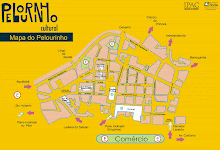
• MAPA DO PELOURINHO

Clique na imagem para ampliar
Fonte:http://tinyurl.com/mndjrb

21.8.09

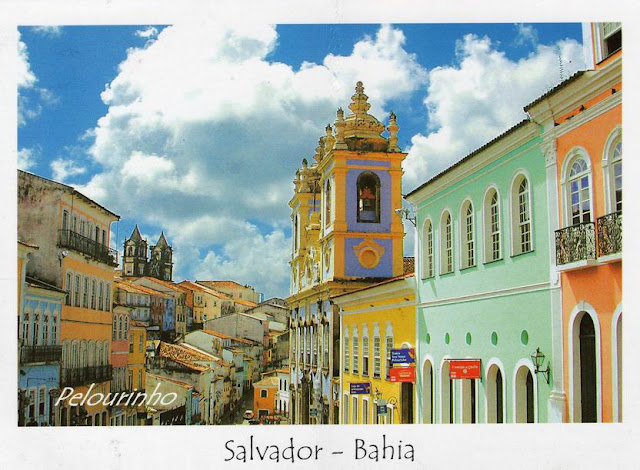
Brazil - Pelourinho in Salvador, Bahia by jasmine-postcards


P256 - Brazil - Pelourinho in Salvador, Bahia


Pelourinho, Salvador, Bahia, Brazil (UNESCO WHS)


Salvador is a city on the northeast coast of Brazil and the capital of the Northeastern Brazilian state of Bahia. Salvador is also known as Brazil's capital of happiness due to its easygoing population and countless popular outdoor parties, including its street carnival. The first colonial capital of Brazil, the city is one of the oldest in the country and in the New World; for a long time, it was also known as Bahia, and appears under that name (or as Salvador da Bahia, Salvador of Bahia so as to differentiate it from other Brazilian cities of the same name) on many maps and books from before the mid-20th century. Salvador is the third most populous Brazilian city, after São Paulo and Rio de Janeiro, and it is the ninth most populous city in Latin America, after Mexico City, São Paulo, Buenos Aires, Lima, Bogotá, Rio de Janeiro, Santiago and Caracas.

The city of Salvador is notable in Brazil for its cuisine, music and architecture, and its metropolitan area is the wealthiest in the northeastern region of the country. Over 80% of the population of metropolitan region of Salvador has Black African ancestry. The African influence in many cultural aspects of the city makes it the center of Afro-Brazilian culture. The historical center of Salvador, frequently called the Pelourinho, is renowned for its Portuguese colonial architecture with historical monuments dating from the 17th through the 19th centuries and has been declared a World Heritage Site by UNESCO in 1985.

Unesco World Heritage Site, Salvador de Bahia


After another overnight bus, we arrived in Salvador de Bahia famous for preserving traditional Bahian culture, samba music, the martial/dance art of capoeira, Rastafarian religion and for the worlds biggest party known as Carnival!!

We arrived early around 6am then took a cab to Hotel Estrela in Pelourinho, the historic district of town. Pelourinho means whipping post in Portuguese and the location was a major slave auction port outlawed in 1835. When we arrived we were greeted by an incredibly nice receptionist who had been working at the Hotel for over 14yrs and learned English by watching movies!!

Due to the dreary rain I took a 3-4hr nap and John drew a beautiful church dome (Igereja da Misenicordia) that was just outside our bedroom window. The view from our hotel was incredible. From the terrace we could see Praca de Se with Catheral Basilica, Praca tome de Souza, Terreiro de Jesus, and Cruzeiro de Sao Francisco. Around 11am we ventured out into the city where we were immediately approached by street people of all ages asking for money, food etc. Due to the heavy rain we quickly made it to a nice restaurant called MamaBahia where live music was
Artist with backward guitar
MamaBahia Restaurant
being played by a musician whose guitar arm was inside the body of the guitar. Very interesting.

MORE interesting than that was what happened on our way back to the hotel. As we were making our way along the sidewalk there was a man walking toward us. He was around 50 and was wearing nothing but a man's bikini bathing suit. No shoes, no hat and the rain was freezing. It was obvious he was a bit off his rocker. Instead of walking across the street to the other side we continued to walk towards him not thinking he'd notice two gringos in bright red raincoats. John walked past him with no problem, but as I looked up the crazy man and I made eye contact! Oh shoot! Immediately he threw up his arms, screamed and started running at me. I made it across the street but not in enough time to avoid the heavy punch that the crazy grape smuggler threw at me. I was terrified!! After the punch the crazy man continued running down the street. The punch apparently relieved him of whatever pissed him off. Thank goodness!!! I thought I was going to have to wrestle
Gorgeous Church
Gorgeous Church
Igreja e Convento Sao Francisco
with a half naked crazy man for my life!! (John: It all happened so fast in the pouring rain. I heard a man scream, which startled me but I honestly didn't think much of it and only a second later heard Chrissy yell! I turned around to find her running in one direction with her arms shielding her head and the crazy man running away in the other. My first thought was he had only scared her but after catching up with her and realizing what had happened the man was long gone. The incident definitely was a wake up call, we were really lucky, things could have been much worse. We are continually approached by street people and have become quite used to it, but since then our guard has been up and we are more cautious of the crazies that we keep crossing paths with.)

After that nonsense for the remainder of the day we stayed close to our hotel. We spent the evening enjoying a few drinks at the neighboring restaurant, where the owner fed the local street people to keep them at bay. As if the day events weren't enough, we watched drug exchanges, prostitutes,
homeless people, and wild cats and dogs take over the streets. We quickly realized that although Pelourinho's cobbled streets and colorful houses are the safer areas of the city, it's not a place to be explored at night. Lucky for us we didn't have to walk far and were relieved once we were inside our guarded hotel. Fun stuff.

We also encountered a young boy of about 12-13yrs who lived on the street. He spoke excellent English and every time he saw us, asked for food. We tried to give him money for food, but later found out that he was so addicted to drugs he knew that he would only spend money on the addiction. So after a day of meeting him we bought him a giant hot dog but he made a scene when we didn't buy him a drink as well! Crazy huh?

The next few days we really enjoyed Salvador. We visited Igreja e Convento Sao Francisco a GORGEOUS golden church, Moderna Meracado a fun market, and did various shopping throughout. Awesome jewelry, art stores, Capoeira dancing everywhere, and lovely decorated ladies!! So much artistic talent to see. One evening we went to Museu
de Art Moderna to see a Jazz Jam. (Recommended by folks at Cafe Zuma... great place as well). Various artists from around the city got together and just jammed! Most interesting was random artists who broke out with flute tunes and freestyle rap with the famous jazz tunes of Miles Davis, John Coltrane and much more. Also there was a local drunk with a giant umbrella dancing for the band and audience.

The original plan was to head north to the Amazon River and do a boat/river float. After talking with various people and after serious evaluation of time we decided to skip the float. From what we learned you spend 5 days floating on a giant boat with hundreds of other people and you do not see the wildlife you would expect. Sooo... we decided to fly to Bogota, Columbia.

At 4:00am the next morning, we grabbed a taxi to the airport and were delighted by the roller skating security guy, whistling a tune as he gracefully whizzed past! haha


Church and Convent of Saint Francis
Catedral Basilica de São Salvador
Old Sun Dial
Old Sun Dial
Church and Convent of Saint Francis
Chess Burger anyone?
Our favorite dive
Love those old cathedrals
Igreja e Convento Sao Francisco
Jazz Jam
Jazz Jam
Museu de Art Moderna
Great view of Bay
Great view of Bay
Moderna Meracado and Forte Sao Marcelo

19.8.09


Salvador da Bahia – City of All Saints (and Almost All Sins)

It’s a good thing we love buses because Salvador was a whooping 22-hour (one way) bus ride away. We spent 4 days and 3 nights in Salvador, Brazil’s culture capital, famous for its Afro-Brazilan culture, powerful rhythms of the drum corps, mystical Candomblé, capoeira circles, and food with a heavy West-African influence.

Our super comfy back seats, strategically located next to the fridge with cold water

The highlights included…

… the historic city tour. Our guide, Josué, was hilarious! Not only did he take us to all the “traditional” tour places but also the tunnels that connect the churches in Pelourinho (some think they were used for smuggling, secret romantic encounters, and/or illegal slave trade but no one knows for sure). Our guide even had Joana stick her hand down a 300-year-old church toilet to take a picture of what was beneath it (surprise, it was trash).

Us in the heart of Pelourinho

…the Candomblé ceremony. Candomblé is a little-understood religion, rooted in Bahian culture, that was brought over by West African slaves. The candomblistas worship orixás, or powerful spirits, and if a person has the gift, he or she can become a medium for the spirit. Interestingly, there are female, male and bi-sexual orixás. The ceremonies can last for hours. First, the performers, all dressed in white, go around in a circle in a dance meant to invite the spirits. Afterwards, the dance becomes more heated and the bell is added to the three drums to conjure the spirits. Then one or a few of the candomblistas become “possessed” by the spirits, which manifests as shaking, writhing and shrieking. Many of the orixás became syncretized with catholic saints over time and as a result candomblistas often go to both a Catholic church and a Candomblé house (our Candomblé house actually had a Catholic altar above the orixá drawings).

Joana in the women's section, drawing of orixás and a catholic altar in the background

… island hopping in Baía de Todos os Santos (Bay of All Saints). The morning was not promising with intermittent torrential downpours, however the boat had a band and a bar, both guaranteed to brighten any day. When we got to the first island, Ilha dos Frades, it was still raining, so everyone decided to make the best of it and just load up on chope beer. With enough beer in them, some people (Galina included) actually went swimming and afterwards showered right on the beach (the shower was conveniently available right in the middle of the barraca). We also ended up buying matching bracelets from a vendor named Julio Cesar (because he was born on Bahia’s Independence Day – see the connection? We don’t either.) Galina got a bracelet for love and Joana’s was for happiness. By the time we left the first island, the weather was beautiful! The second island, Ilha de Itaparica, was much larger. On our island tour, we stopped by Fonte da Bica (fountain of youth), mineral water fountain from 1842, which had 3 faucets: love, health and money. Naturally, we drank from all 3. Just to annoy Joana, the guide told the story of a Portuguese man who visited the island and went to the fountain every day to pour the water down his pants, until someone (the guide claimed to have been himself) told him that although the fountains rejuvenates, it does not resuscitate. On the way back, the band played popular Brazilian tunes and the passengers, warmed by beer (and caipirinhas!), sang along. One of the band members ended up getting Galina to get up and dance with them, which proved to be a feat of balance, since the boat was rocking quite a bit. Thank you, vestibular system, for not failing Galina at the time of need (yes, we are in med school).

island #1, which only had 70 residents

on island #2, out local guide was really excited that Joana was Portuguese

At an old Dutch (or Portuguese) fort in Itaparica

The Fountain of Youth - Galina drinking from the "love" faucet, Joana from the "money", "health" is in the middle

Dancing/balancing on the boat, one of the band members looked a lot like Jamie Foxx

… samba dancing. Friday night, we went to one of many outdoor bars for some chope and live music. Later on, the street turned into a dance floor. After a few dances, we got invited to another venue for some samba dancing. We ended up being the only non-Brazilians there (finally, a non-touristy place) and had a blast learning to samba from Bahia’s best. Galina even got to dance with a dance teacher (or so he claimed) who actually turned out to be a wonderful instructor, said she was doing pretty good (for a white girl?) and gave her a necklace as a presente. Overall, it was a productive night – we greatly improved our samba and made some friends who walked us back to our hotel safely.

Samba starts on the streets of Pelourinho, then moves into the clubs

…the ribbons. Everywhere you go in Salvador, people will offer you different colored ribbons from Lembrança do Senhor do Bonfim da Bahia. You are supposed to tie the ribbon around your wrist in 3 knots, making a wish for every knot. Taking the ribbon off invites doom, so you just have to wait for it to fall off on its own. Joana cleverly picked a pink ribbon, which may not match any of her clothes but would certainly match a sunburn (thanks, equator!).

Pink is for love, purple is for health

… sad stuff. Salvador has many street dogs (Praça da Sé) and cats (everywhere else) that have to beg for food from tourists and go dumpster diving. Sadder still, is that walking back from samba at 3 AM, you can see little kids dumpster diving along with the homeless animals. The financial chasm between the tourists that seem to flood Pelourinho during the day and the kids who scavenge for their leftovers at night is truly staggering.

… the food. Bahian food is heavily influenced by its African origins and often cooked with dendê oil from West African palm. One of our favorites was the traditional moqueca – a delicious stew made with coconut milk, dendê oil, seafood and laced with malaguetapepper. Naturally, everything is served/cooked with farofa (manioc flour), which turns food yellow. In fact, yellow is now our favorite flavor. Acarajé, bean and shrimp fritters, were ubiquitous, huge, and incredibly filling.

The deliciousness that is fish moqueca (its yellow, of course)

… the music. The city is pulsating with rhythms of samba, reggae and just about any other type of music. Almost every bar and restaurant has live music by local performers, all of whom seem incredibly talented. How is it that a city like Salvador is overflowing with truly talented and original performers and then someone like Britney Spears makes it?

… Olodum. Olodum is the more famous of Salvador’s drum corps, they even did a video with Michael Jackson, which everyone in Pelourinho will happily remind you and even show you the exact streets and buildings where the taping took place (by the way did you hear he died?). We saw some of Olodum’s apprentices (some as young as 5) form a procession down the streets of Pelourinho. They were really good.

One of the drummers - they occasionally pick up the drums and throw them in the air (heavy metal drums, that is)

… capoeira. Capoeira, which was developed by the slaves as a means of self-defense against their masters, is said to have originated from a ritualistic Angolan dance. Capoeira was prohibited by slave owners and thus developed into a disguise of acrobatic dance. Now, capoeira circles are seen all over. The main instrument that accompanies the dance is the one-stringedberimbau, which Galina acquired for $5 at one of the music stores, along with a stick and a rock needed to play it. God help her neighbors.

Capoeira circle on the street

… last, but definitely not least, shopping! The art in Salvador is everywhere! Many artists just set up shop on the streets of Pelourinho, while others occupy little stores and galleries. We went to several venues and galleries before settling on a few amazing pieces.

The art is everywhere!!!

P.S. Every 3-4 hours, the bus would stop at rest stations, which had little stores and food vendors. At one of the stores, we encountered Marx’s Communist Manifesto, on no other than a love advice literature shelf, right behind Sex Without Doubts. For some people, its photo-shopped images of supermodels, for others it’s the picture of proletariat as “grave-diggers” of the bourgeoisie. Go figure.

Communist Manifesto - always a good read (right after Sex Without Doubts)

The bus also entertained us with some videos from the 80s, including classics like “Total Eclipse of the Heart” and “Love hurts.” Along with the oldies, they threw in an occasional Britney and Backstreet Boys – are they considered oldies now, too? Are we that old?

As always, additional pics are here: http://picasaweb.google.com/jperd114